
Mandatory tachograph for LCVs > 2.5 t: what to do before July 1, 2026
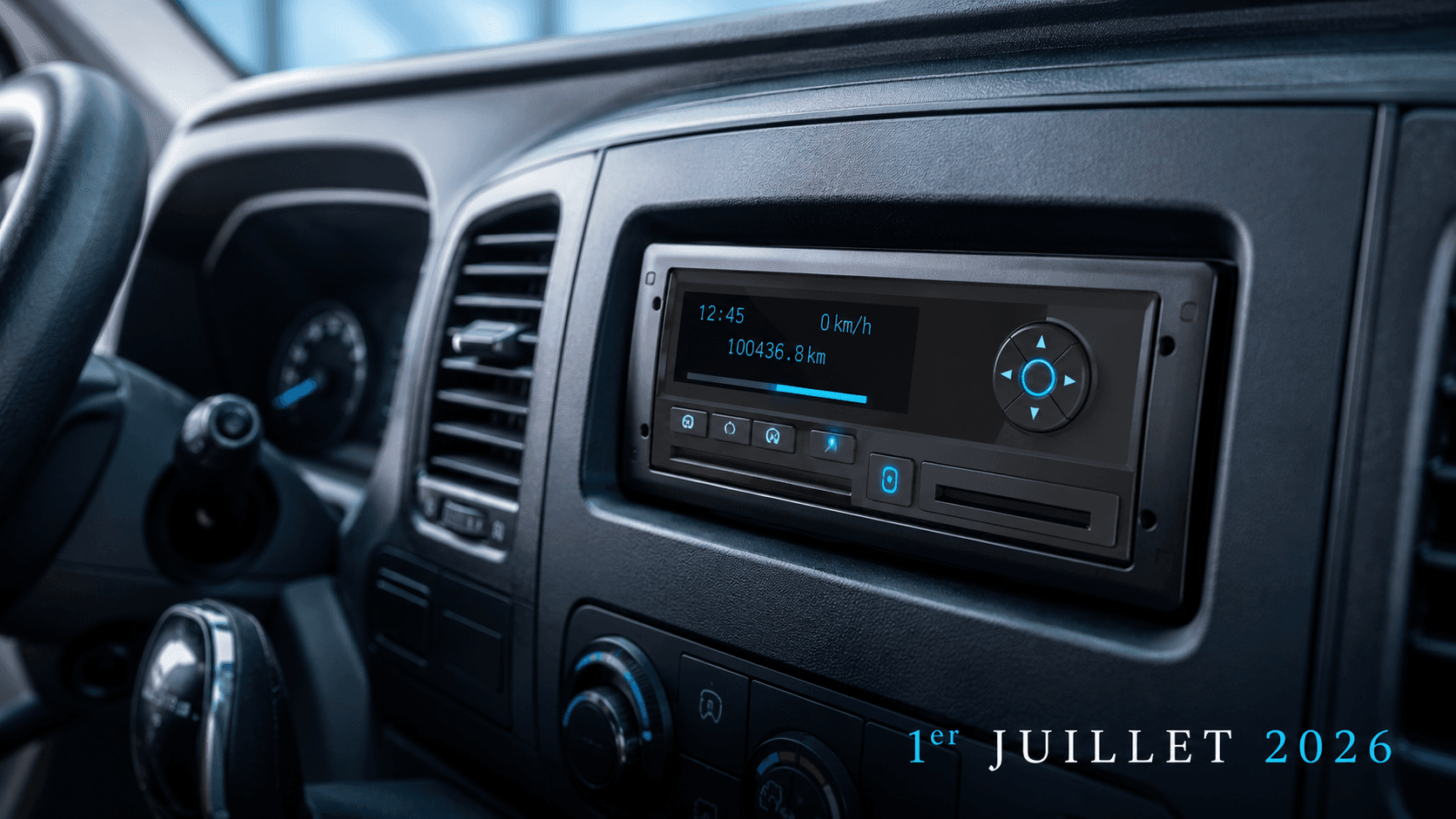
If you run vans over 2.5 tonnes for international transport or cabotage, July 1, 2026 will change your day-to-day operations. On that date, these vehicles fall under the smart tachograph rules, exactly like heavy goods vehicles. In short: you can no longer operate the way you used to. Here is what changes, why it concerns you, and above all what you can do right now.
What exactly changes on July 1, 2026
The European Union’s Mobility Package extends the smart tachograph requirement (Gen2 V2, DTCO 4.1a) to a new vehicle category. Until now, the “large LCV” (the long-distance van of around 20 m³) was almost entirely unregulated, which is exactly why it boomed in e-commerce and express delivery.
- Any LCV with a GVW above 2.5 t (up to 3.5 t, trailer included)…
- …as soon as it performs international transport OR cabotage…
- …must be fitted with a Gen2 smart tachograph.
- Drivers fall under driving and rest time rules (Regulation 561/2006).
- The rule applies to new AND existing vehicles (retrofit mandatory).
Note: purely national transport stays under the 3.5 t threshold. And a craftsman transporting their own equipment is not concerned. The real target is the international van.
The “wall of hours”: why it blocks your deliveries
The tachograph automatically records everything: driving time, breaks, rest, speed, border crossings. No more “adjusted” hours. European social regulations impose strict limits that are now impossible to bypass:
- 9 h of driving per day (extendable to 10 h, twice a week).
- 45 min mandatory break every 4 h 30 of driving.
- 11 h of daily rest (reducible to 9 h, three times between weekly rests).
- 56 h of driving per week, 90 h maximum over two weeks.
A trip like Berlin → Paris is about 1,050 km and 10 to 11 hours of driving. It is legally impossible in a single day. Before 2026, the van pushed through anyway. Now the tachograph prevents it: without a relay, that means +1 day of lead time and late parcels.
What to do? 3 concrete solutions
1. Two-driver crews (expensive)
Putting two drivers in the vehicle lets you drive longer. But it doubles your staffing cost on every trip, and finding available drivers is hard in an already tight market.
2. Splitting the trip with rest stops (slow)
Complying with the law by scheduling the 11 h of rest on the road. Legal, but it adds at least one day of lead time, often a deal-breaker for express or next-day commitments.
3. The border relay (fast and compliant)
This is the most effective solution: the foreign carrier stops at the French border and drops off its parcels at a cross-dock depot. A local operator then takes over for the last mile, everywhere in France. The foreign driver never crosses France: they don’t burn their driving time, they head back immediately, and the delivery time is met.
The border relay in practice with Easy2go
Easy2go runs this relay in both directions (import and export), with 7 depots in France (Paris, Lille, Strasbourg, Nice, Lyon, Bordeaux, Toulouse) and a 300 km coverage radius around each. You book a handover slot online, drop off at the border, and we handle delivery to the end customer, for all parcel types, from standard to bulky.
Book a border relayIn summary
- On July 1, 2026, LCVs > 2.5 t on international routes switch to the tachograph.
- Consequence: you can no longer cross France in a single run (9 h / 11 h imposed).
- Three options: two-driver crew (costly), splitting with rest (slow), or border relay (fast and compliant).
- The border relay lets you meet your deadlines without changing your organisation.